

Quantum Technologies: Trends and Implications for Cyber Defense
The newly published book “Quantum Technologies: Trends and Implications for Cyber Defense”, an Open Access volume by the Cyber-Defence Campus, offers a timely and comprehensive overview of how emerging quantum technologies are poised to reshape cybersecurity and cyber defense.
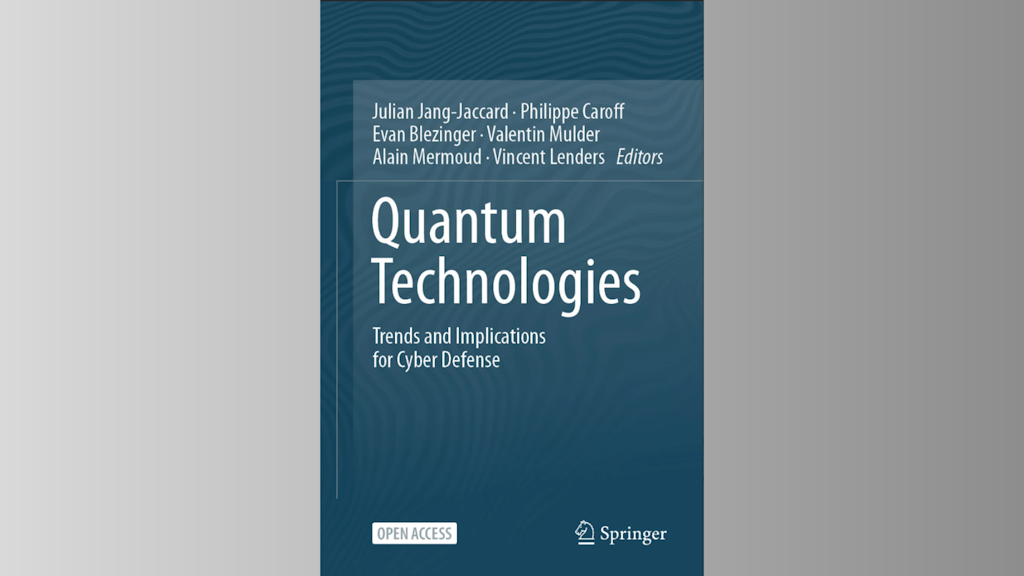
Edited by a distinguished international team including scientists and practitioners from research institutes and academia, the book assembles the latest insights on quantum computing, quantum communication, and related quantum-enabled capabilities.
The volume is structured in three thematic parts. First, it surveys core advances across different quantum computing paradigms (e.g., superconducting qubits, trapped-ion systems, neutral-atom approaches, semiconductor spin qubits), quantum error mitigation strategies, quantum optimization and quantum machine learning, providing a state-of-the-art snapshot of the quantum computing landscape. In the second part, it delves into quantum communication technologies, including quantum key distribution (QKD), quantum random number generators (QRNG), and post-quantum cryptography, with a view toward understanding how these technologies can provide resilience against future cyber threats. Further, the study discusses strategic, operational, and policy-relevant implications for cyber defense: it outlines how quantum technologies may disrupt existing cryptographic standards, assesses readiness of enterprises and institutions, and presents recommendations for adaptation and future planning in cybersecurity.
With its breadth, from technical quantum-architecture overviews to strategic cyber-defense implications, this study constitutes a key milestone for the CYD Campus mission: equipping Swiss institutions, industry and academic partners with the knowledge required to anticipate, plan for, and respond to quantum-driven changes in the cyber threat landscape.
As an Open Access publication, the book is freely available for download in PDF and EPUB formats, making it accessible to researchers, cybersecurity professionals, government agencies, industry stakeholders and all interested parties.