

People & Connect
Talk with Yago Lizarribar
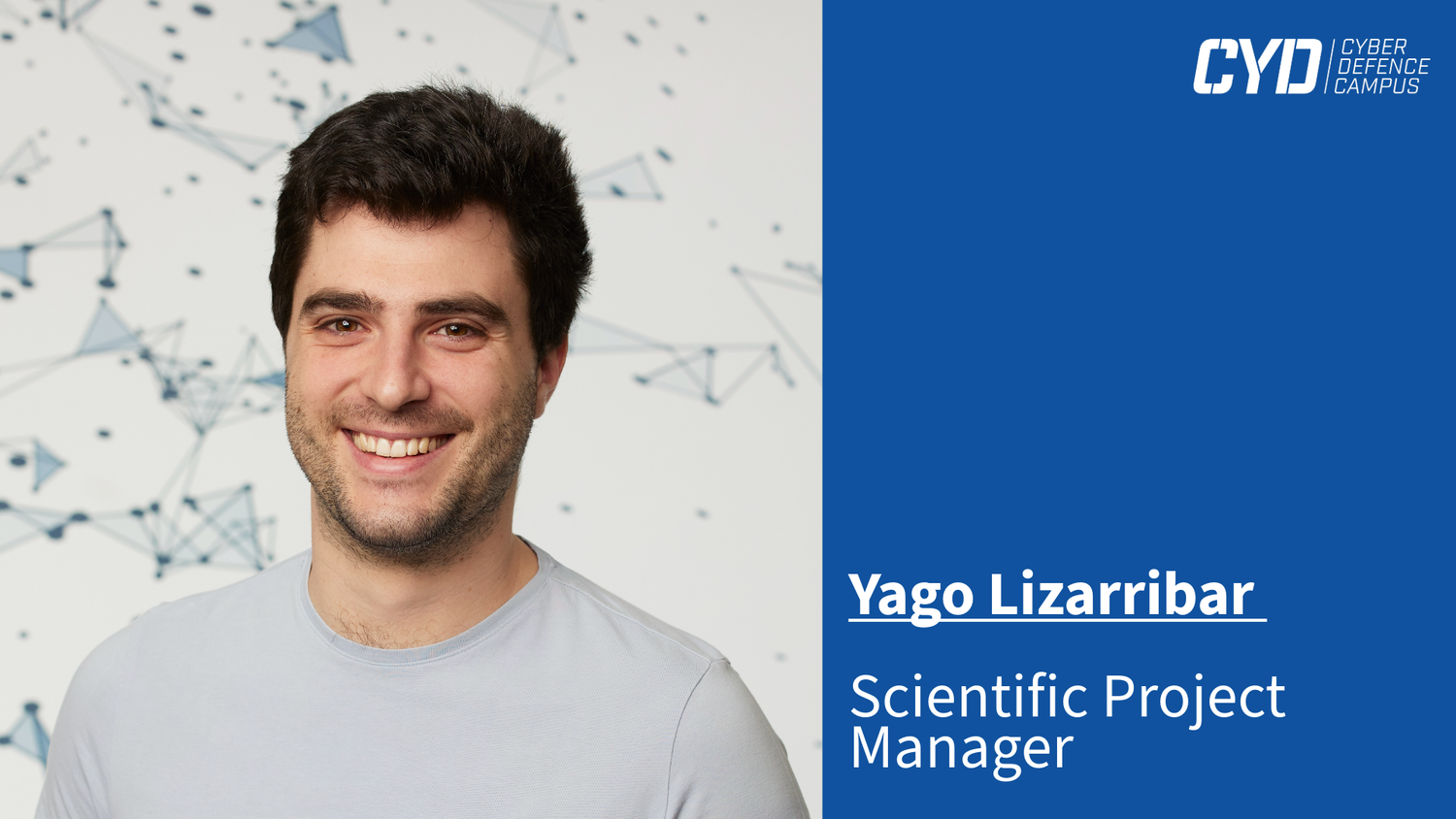
How long have you been working at the CYD Campus and what motivated you to join us?
I've been working at the CYD campus since the beginning of the year, but it's not the first time I've been at the CYD Campus. When I started my PhD in Spain, I already visited and worked with armasuisse and the CYD Campus as an intern in the data science group. The reason why I joined is because I really like the environment, the people and the topics we are working on.
What motivated you to change your country for this job?
I knew the people here, that's a big advantage when you move somewhere else. You know the people you're going to work with and you like them. There are also more personal reasons such as: I like Switzerland, I like life here and the quality of life. At the moment I have a temporary position, so I said let's take the step. So, it was absolutely fine for me to move to Switzerland.
What is your doctorate about?
Broadly speaking it's about telecommunications engineering, and more specifically I did it on spectrum monitoring and spectrum monitoring analysis. There was this project called Electrosense with deployed sensors around the world and trying to collect data about the spectrum and then analyze the modulations, the use of the spectrum or localize the signals, which is also a big part of my thesis.
In which area do you work at the CYD Campus?
I work in the former data science group, now called the cyber data technologies group. Specifically, I work on a few projects, the main one being the fit on duty project, which is about predicting heat illness or sports illness in soldiers or military personnel. We also have a smaller project related to aerial spectrum monitoring and spectrum monitoring analysis.
Which of the research projects you are working on do you think offers interesting opportunities?
The fit on duty project, I think it's quite interesting for the military, especially for their young soldiers, because right now there's no real knowledge of when a soldier might collapse or under what conditions stress might start to affect the physical performance of soldiers. These kinds of monitoring technologies for athletes in general are really on the rise at the moment. And to be able to come up with a solution that can predict whether a soldier is physically fit and inform the platoon leader, for example, that the soldier is about to collapse - that would be huge in terms of results and could be really useful for a lot of other applications. So, I think it has a lot of potential.
What relevant trends do you see in the cyber sector in the near future?
In data science, there are actually many. The reason for that is the popularity of LLMs, which is opening up a huge field, especially when it comes to security, privacy and the production of fake news. We've seen that if you put large speech systems into a lot of production systems endlessly, those security systems can be bypassed and really harm the companies or products that rely on them. And I think it's only going to get worse in terms of how hard you have to protect against it. Every week we have bigger language models, now we have Gemini 1.5 with 1.5 million context windows. That means we can produce an hour's worth of video or a day's worth of audio in a matter of minutes. These systems can produce so much more data so much faster, and they can produce so much more problems so much faster. Somebody can very easily fake what they want without a lot of inside knowledge about video production. And that creates a big problem and challenge for data scientists, how to really secure the systems, how to properly design the architectures that take these risks into account for safer products for everyone. There are more and more systems that rely on machine learning, and it's also very important that we understand why the machine learning products or models make these decisions.
How is research at the CYD Campus different from other research institutions where you have worked/are working?
Compared to Academic institutions, for example, I think it's more tied to industrial topics or to real-world problems. At the university, you end up working on things that have much less applicability. From a scientific point of view, maybe that's ideal. From a societal perspective, you want to have as much impact as possible. I think the CYD Campus’ approach is a bit oriented towards to this goal. I've also worked a little bit in the US and there it was more product- or industry-oriented research and I think the CYD Campus is a little bit more in that direction, which I like, because it's not just that you're building or researching, but it has more concrete or impactful outcomes, like fitness for duty, which has a direct impact on the health of a lot of soldiers and, by extension, the health of a lot of people.
Why would you recommend working at the CYD Campus to other people?
The environment is nice, even though it's in Thun - which is a bit far for me from my home in Muri - I like coming here. I am a thinker, an engineer, I need to tinker with things, I need to have things and cool hardware to work with. And usually there's a lot of opportunities here at the CYD Campus. Whatever I can think of, there's a piece of equipment I can use to do it. I think it's great for a thinker like me. It's extremely valuable because I can test ideas and things I want to do really quickly without a lot of bureaucracy, which isn't always the case in other companies. You can use different labs very easily.
Where do you see yourself in 5-10 years' time?
That's a difficult question. I'm not sure, because it's something personal and how I manage things with my girlfriend or my partner. I wouldn't mind being at the CYD Campus or in Switzerland in the middle term, but it's hard to think about ten years from now. It's so far away. So far, I am happy with the direction I am going now. I like data science because it basically allows you to touch many subfields at the same time, at the moment I am doing health, but I am also doing telecom. That is not usually the case in other areas of research. I see myself working in data science and there are a lot of good opportunities to work in data science.